LeBron James Is a Free Agent. Here's What Every Destination Means for DFS.
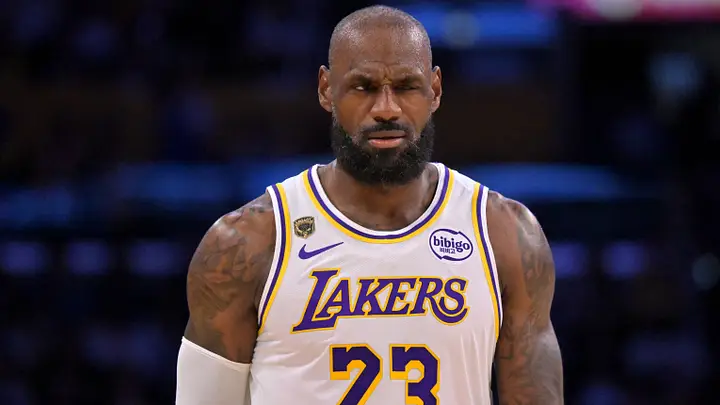
LeBron left the Lakers. Rich Paul confirmed it Wednesday: "pursuit of complete happiness." The reported suitors are Cleveland, Miami, and Golden State. No timeline on a decision.
No NBA slate runs in the offseason, so this is not a pick for tonight. This is the thinking that separates DFS players who are ready when the season opens from those scrambling with outdated salary assumptions in October.
Three scenarios. Here's what each one does to the value map.
Scenario 1: LeBron to Cleveland
Cleveland is the best DFS outcome for LeBron's personal fantasy value, and it's not particularly close.
The Cavaliers have Donovan Mitchell, James Harden, and Evan Mobley. That's a strong supporting cast, but none of them are ball-dominant enough to compress LeBron's usage significantly. In Cleveland, LeBron would be the offensive gravity anchor. His usage rate would likely settle in the 29-32% range, similar to his better Laker years.
The roster construction argument: Mobley is an elite defensive anchor who keeps possessions alive and creates transition opportunities. Mitchell is the secondary scorer who takes enough heat off LeBron that his legs stay fresher late in games. Harden's passing is more complementary than competitive — he's a willing playmaker who thrives alongside another primary creator. This is the environment where LeBron's DFS floor is highest because his role is clearest.
What it does to Cleveland's secondary players: Harden and Mitchell both see modest usage compression (roughly 2-3% each), but neither drops out of DFS viability. Mobley stays on his usual defensive/rebounding production line. The Cavaliers go from a good DFS team to a must-build team on the right slates.
The history matters here too. LeBron's first stint in Cleveland produced some of his highest-efficiency seasons. He returned to a familiar offensive system and performed better than his Laker years on a per-possession basis.
Scenario 2: LeBron to Miami
Miami already signed Giannis. Now add LeBron.
On paper, this is an historic frontcourt. In DFS terms, it creates real valuation problems that will take most of the preseason to sort out.
The compression issue: Giannis requires the ball in the post and in transition. LeBron requires the ball in creation and isolation. They cannot both operate at full capacity in the same 48-minute window. Historically, LeBron-plus-another-alpha rosters have resolved this through positional specialization, but that's easier said than implemented in Year 1 of a new system.
Bam Adebayo is the player to watch. He's already a secondary ball-handler and playmaker, but with both Giannis and LeBron on the floor, Adebayo's role narrows significantly. His DFS salary will reflect his 2025-26 production, not his compressed 2026-27 role. That mismatch creates a fade opportunity on Miami-stack-heavy slates.
LeBron's usage in this scenario likely lands in the 25-27% range. That's MVP-caliber for most players. For LeBron's DFS price point, it represents a roughly 8-10 fantasy point ceiling reduction compared to the Cleveland scenario. The Heat as a unit produce more wins, but less exploitable DFS value per player.
If LeBron goes to Miami, build around Giannis first. Build around LeBron second. Fade Adebayo on nights where both stars are healthy.
Scenario 3: LeBron to Golden State
Golden State maximizes something specific: LeBron's passing upside.
Steph Curry and Draymond Green are both still in the system. Draymond remains one of the best passing bigs in the league. Steph moves without the ball as well as anyone in modern NBA history. Put LeBron at point forward in that system and his assist total goes up while his scoring burden goes down.
This is a unique DFS environment. LeBron in Golden State likely produces a 7-8-7 stat line on most nights (points, rebounds, assists) rather than the 25-7-7 he'd post in Cleveland. The floor might actually be comparable. The ceiling is lower.
For Golden State's secondary players, the value math is interesting. Brandin Podziemski is a young player who would see usage opportunities on nights where LeBron rests. That's the play to track early in the season before the rotation stabilizes.
The age question is real: LeBron turns 42 in December 2026. Steph turns 39 in March. Both are well-preserved players, but managing minutes in a season designed to peak in April means more rest nights. Rest nights create lineup traps for DFS players who don't track the rotation.
Golden State is the highest-risk DFS destination for building around LeBron. The environment is excellent. The role clarity is lowest.
What else the offseason is doing to the board
The LeBron decision doesn't happen in isolation. Jaylen Brown moved to Philadelphia. Ja Morant is now in Portland. The Eastern Conference's DFS hierarchy is reshaping in real time.
Philadelphia with Brown and George is an elite DFS target on nights they both play. Portland with Morant gets interesting fast as a value stack on nights the Trail Blazers play at pace. Boston's adjustment to life without Brown is an open question.
The first week of the season, when salaries are set from preseason projections and rotations are still fluid, is historically the best DFS value window of the year. Players who do this thinking now have an edge over players who scramble when the season opens.
The Wanna read
Wanna Parlay's leaderboard format rewards players who get the value plays right, not just the chalk. Free agency decisions that reprice players below their actual production are the best recurring DFS edge.
Monitor the LeBron decision closely. The first credible report of a signed contract will immediately trigger pricing assumptions for everyone in his new market. The secondary players in his destination, before the market adjusts, are where the DFS edge lives.
Get your scenario thinking done now. The decision is coming.
Sign up with code DATA and receive a 100% deposit match up to $250.
All projections are associational analysis based on roster construction and historical production patterns. No holdout study or validated causal model underlies these estimates. Wanna Parlay is a daily fantasy sports app, not a sportsbook or gambling product.

 blog
blog